
5/2/26 Prices
China has announced, again, that it will continue to expand its farmer support programs to help ensure food security and lower its reliance on imports. Considering the level of uncertainty created by the US, and in part China’s own actions, in regards to using tariffs as a trade tool. China’s latest example being with Canada using tariffs on canola to push Chinese made electric vehicles. It’s any wonder they are looking to reduce their reliance on imports. Will they be successful in doing so, time will tell.
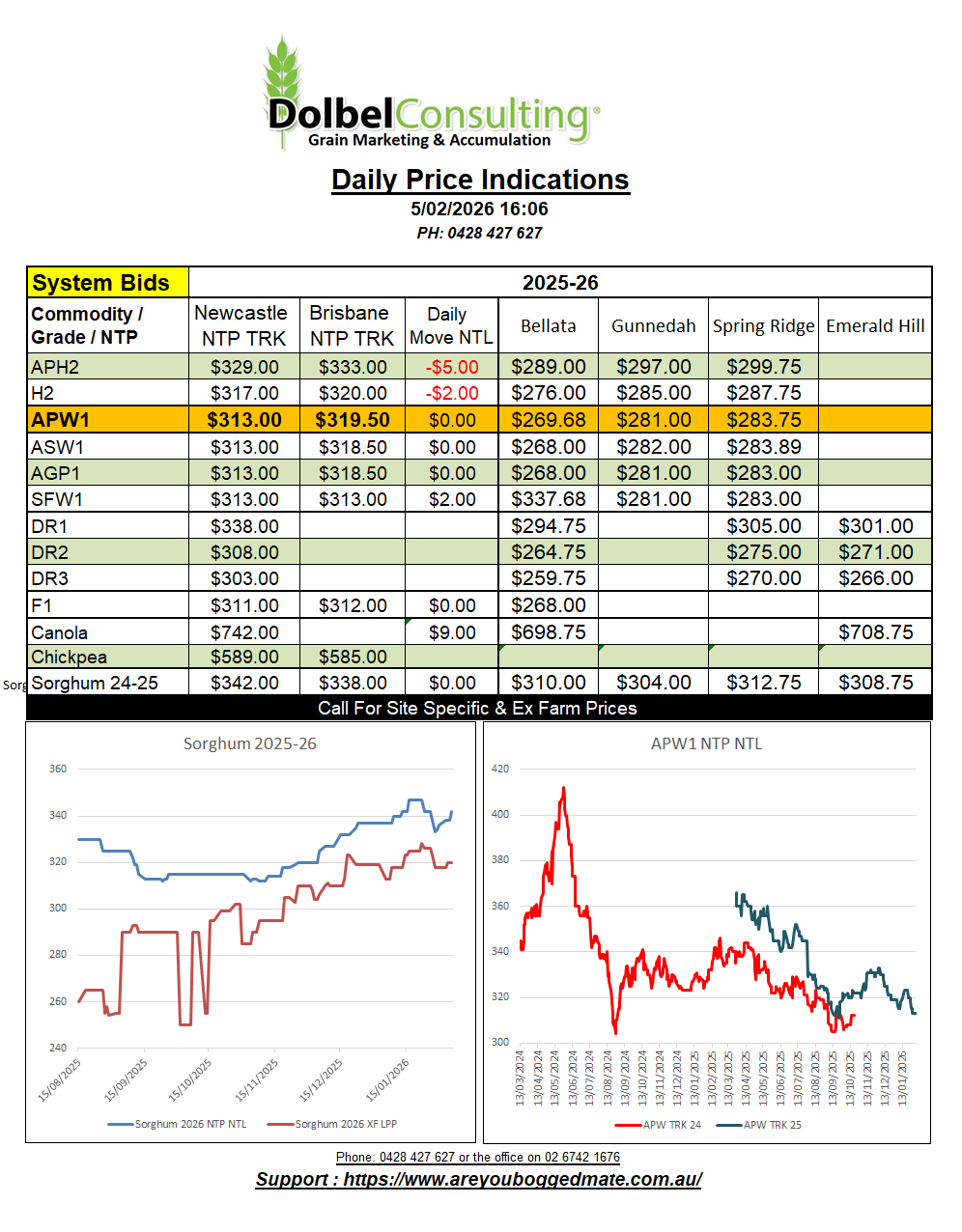
Overnight Chinese values for sorghum and corn were mostly steady. Dalian corn futures increased by just ¥2 per tonne to close at ¥2270/t. The Shenzhen sorghum index was published at US$261 C&F Chinese ports / Feb. On the back of an envelope, we can roughly convert the index value to a ex farm LPP price to use as a guide to what Chinese sorghum imports are indexed at. Currently that number comes in at something close to AUD$330 to AUD$340 per tonne XF LPP. Keep in mind that this is a retail price, there’s no trade margin deducted. This also indicates that current sorghum bids here on the LPP are fair value.
Compared to US sorghum, which would land at China for roughly US$263 +/-, plus a 10% import tariff, so just under US$290. Aussie sorghum at current values are above the index value but below the US value. A similar comparison to Argentina puts the Argentine product C&F China at about US$266, but this also attracts at 8.5% import tariff bringing the net C&F value closer to US$289/t. Almost identical to the US value.
These comparisons do tend to indicate that Aussie sorghum is fair value, but is also the cheaper option for the Chinese importer.
The USDA will publish the February 2026 World Ag Supply and Demand Estimates next Tuesday (Wednesday here). Technical positioning ahead of the report may see limited short covering in wheat, possibly supporting current values. Wheat is expected to remain, less than volatile, through to at least the thaw period in March / April, when agronomist can at least confirm or deny the extent of winter kill in both the US HRWW belt and parts of northern Ukraine.