
24/2/26 Prices
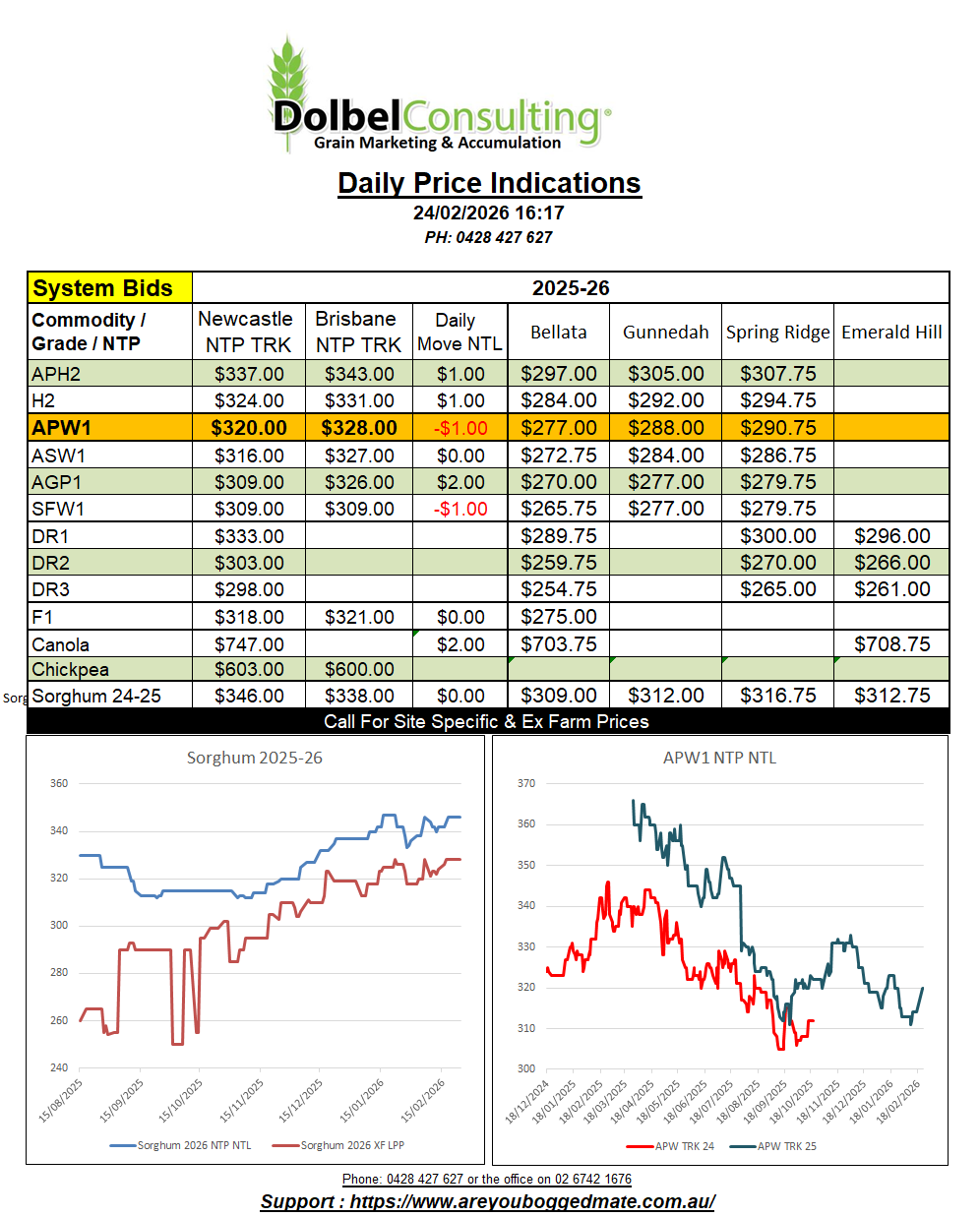
Minneapolis spring wheat futures and Chicago soft red winter wheat futures were softer overnight, shedding some of last weeks upside. The moves in SRWW and SW were minor compared to the move in hard red winter wheat. The downside in HRWW takes the nearby values to less than soft red winter wheat for the old crop. Even the spread between new crop HRWW and SRWW in the December slot was only 9.25c/bu (AUD$4.95/t). The December slot for soft red winter wheat at US$6.1075/bu (AUD$318.13/t) versus US$6.20/bu (AUD$322.95/t) for HRWW.
The difference in value of US futures from the May 26 slot to the Dec 26 slot, old crop vs new crop, is also minimal. The difference in SRWW is +AUD$19.27/t and the difference in HRWW is +AUD$24.61/t. That’s not a bunch of carry for 7 months, less than AUD$3.00/t/mth.
Keep this in mind when budgeting with wheat. The market, at present, isn’t factoring much change in wheat prices over the next 6-12 months. This isn’t unusual for mid to late February though. Both northern hemisphere and southern hemisphere wheat has a hell of a long way to go before it’s in the bag, or in the case of Argentina and Australia, even sown.
A quick look around the world and how seasons are progressing can help us understand where, or if, any issues may arise. The first place that is showing some cracks in the season, but isn’t an issue yet, is parts of SW Europe. Spain has had a lot of rain and is now moving through an unusual warm period. The heat is also pushing through much of France. This is seeing winter wheat break dormancy much, much earlier than usual. The wheat has seen enough cold weather to move towards its reproductive phase of growth too. This has a few punters thinking of wheat flowering weeks earlier than usual. The main issue with this is vulnerability to frosts. The next location to watch could be Russia. The trade is mixed on the thoughts that ice on fields will increase the risk of winter kill, while others are saying that the snow cover prior to the ice was enough to protect the crop.
Then we could include Australia, no one talking about how dry it is yet. The international market is yet to lift an eye brow to what is developing here.