
26/2/26 Prices
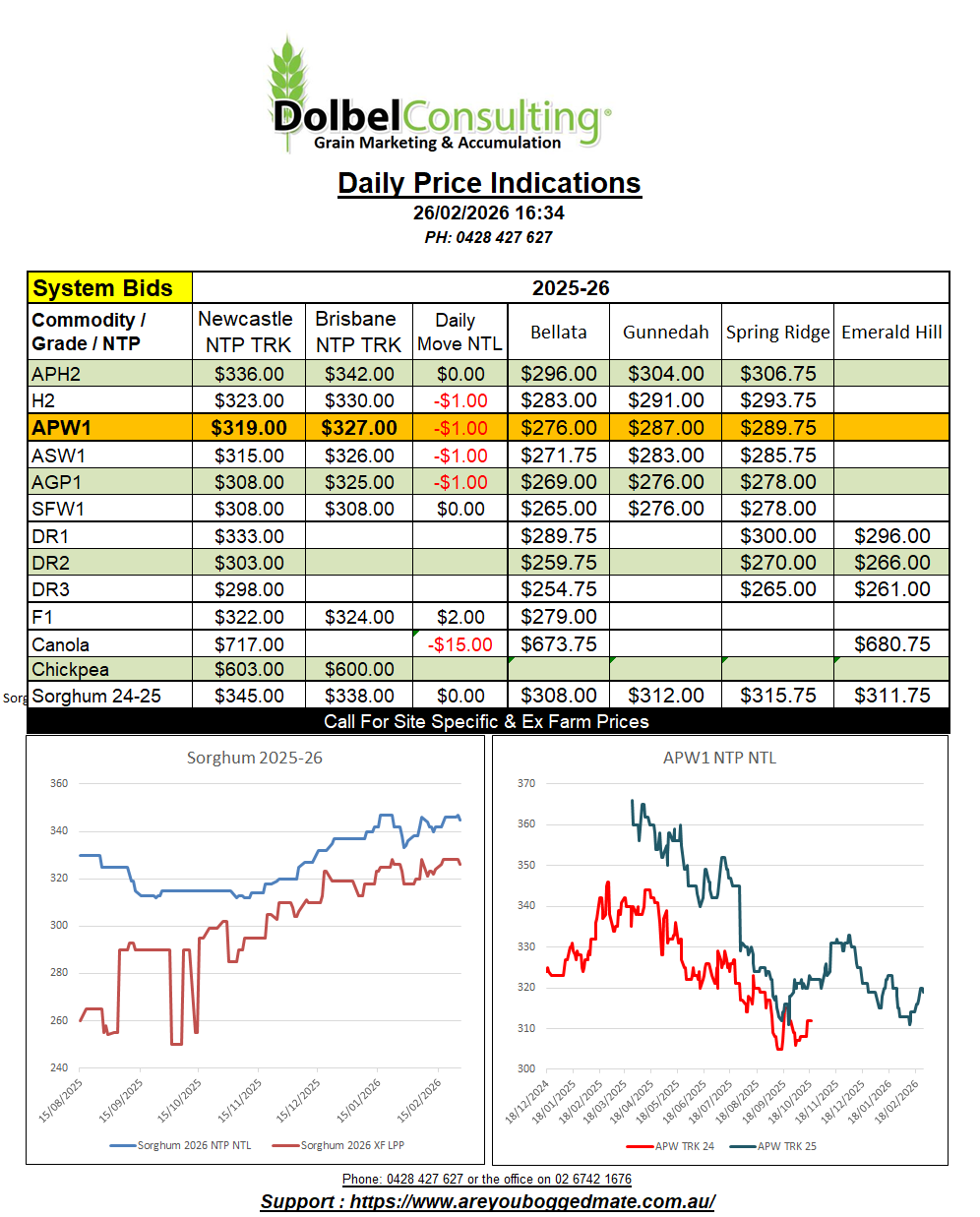
It’s pretty obvious the AUD is going to play a big roll in today’s trade pricing. It has increased, in USD / tonne terms, Aussie products around the world. Aussie milling wheat and sorghum will be the hardest to stop a fall in domestic values. Both grades are primarily export products. Milling wheat has been almost working into a tightening domestic Aussie feed market. Sorghum at current values has little chance of buying significant volume domestically, so may feel the brunt of the higher AUD more so than wheat today.
The rally in the AUD is worth roughly -AUD$2.60 / tonne for wheat. This is more than the AUD / t equivalent move in Chicago SRWW futures which was only about -AUD$0.91/t. The move, even considering the AUD, isn’t a heap. Local milling wheat basis to Chicago has been volatile, moving as high as +70c/bu in early Feb. Currently it’s closer to +41c/bu, thus has the ability to absorb a move like we have seen overnight in both the US futures market and the AUD. The bigger question is will it ? With H2 wheat roughly US$13 more expensive than US HRWW into Asia, it may struggle to buy market share.
Jordon was in the market for feed barley today until offers were limited to just three participants, tender cancelled.
Temperatures across the SE of France continue to remain warm. Much of France has experienced day time temperatures of around 3-5C warmer than average over the last week. The week ahead is expected to be similar, maybe a smidge cooler. Minimal rainfall is also expected to continue across the warmer regions of France too. Over the last 30 days France has seen around 80% of normal precipitation across the major wheat producing regions.
Germany is in much better shape, normal temperatures and above average moisture over the last 30 days should see conditions almost ideal for spring growth in winter wheat. Spain, Bulgaria, Romania and Italy have all seen much more rain than normal. Spain up to 600% more than normal across much of the country. Russian and Turkey are both in good shape with above average rainfall across most of the winter wheat country. Russia also a little warmer now.