
18/6/26 Prices
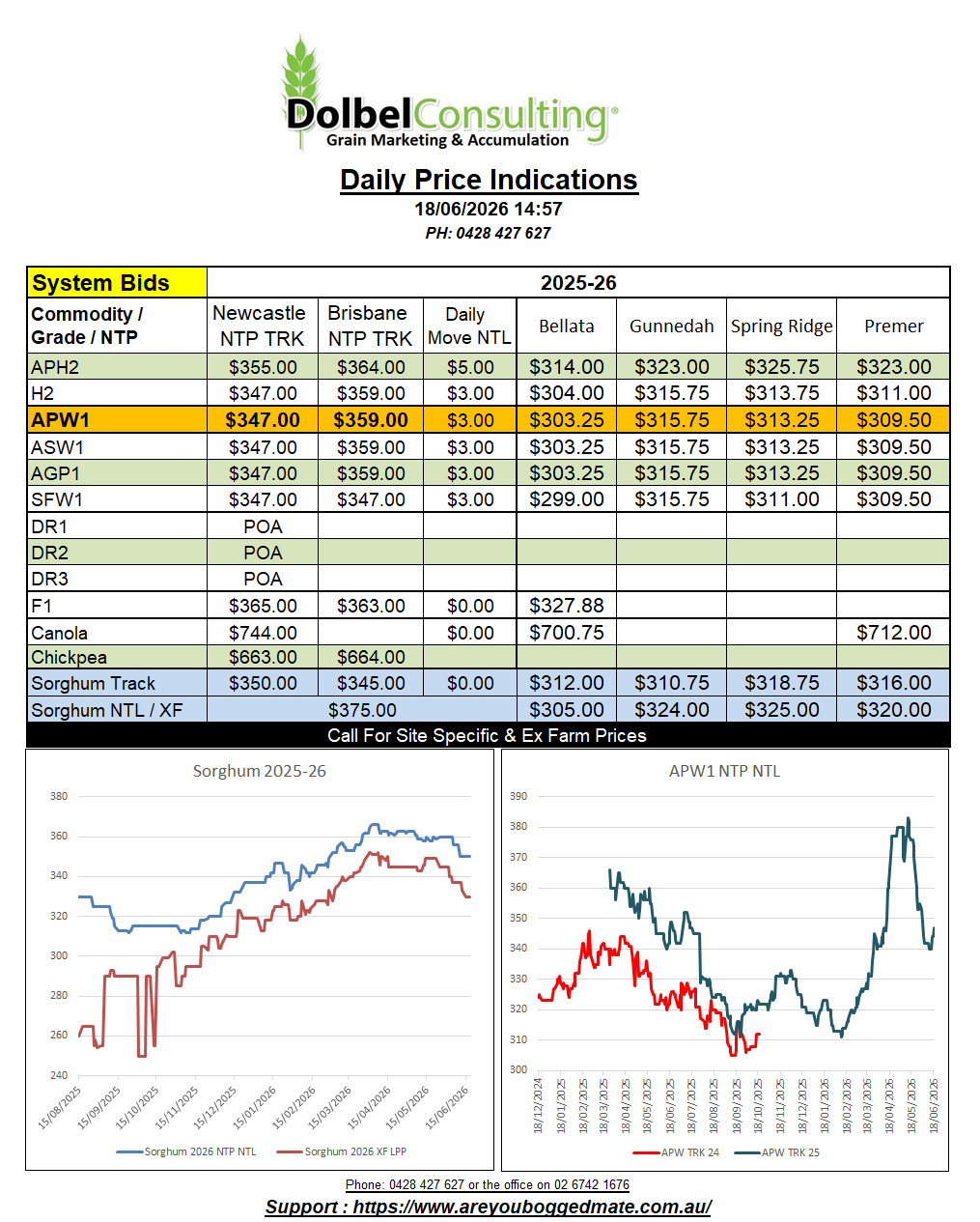
Short covering of June contracts in the Chicago wheat pit saw some upside in US futures last night. One does ponder if there is no fundamental strength in the wheat market. The US wheat crop is the smallest in years. France has seen below average rainfall all year but their crop rating remain high. Now we see Germany and Poland getting dry, and speculation on Russian wheat area not being as big as it was assumed to be. If none of these things can talk the market higher, then no, it appears there is little fundamental strength.
What we are told we are seeing are regional hot spots. For example US HRWW production is much smaller this year. That will have a impact on that region, but they are saying that it is unlikely to have an impact on other regions.
I dived into this assumption yesterday. I’m no expert on the arbitrage capability of the US wheat market, but the numbers I was starting to come up with told me that if US HRWW exports were sustained at the 5 year average, which price might suggest is likely. Then US HRWW ending stocks are likely to fall from something close to 10mt to something closer to 3mt.
Is the US comfortable with this kind of reduction, currently the “futures” market indicates yes. Is the US consumer happy to look at imports from Europe to top up late in the 2026-2027 season if there are local supply issues, possibly yes. We’ve already seen some imports from Poland. This isn’t unheard of for the US mills farthest away from the HRWW belt but would they be happy to “need” to buy from Europe.
Last night cash values for French wheat improved. The Aussie dollar conversion comparison was up by over AUD$15.00 / tonne. This compares to a rally in US HRWW futures of 18.75c/bu (AUD$9.80/t). HRWW values out of the PNW were up AUD$12.72/t compared to yesterdays conversion into the Asian market. This leaves US HRWW at US$1.57/t more expensive that H2 wheat and almost US$10.00 over Russian wheat into Asia. One higher close doesn’t make a rally, but I struggle to see how other exporters, like Russia, will sustain lower prices when they don’t need to. The game is buy low, sell high, after all.