
29/9/26 Prices
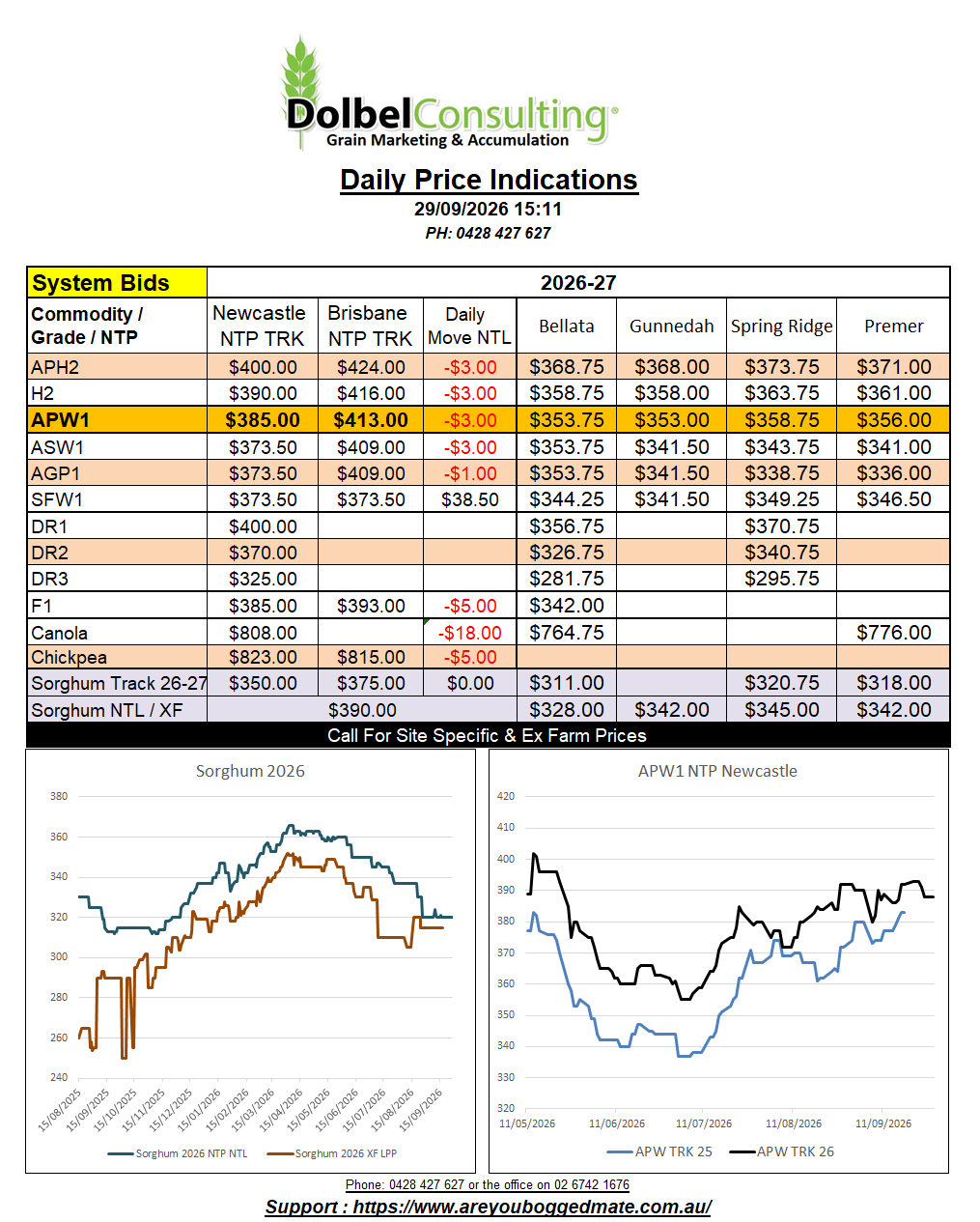
Black Sea wheat exports, Russian and Ukraine, remain half of what they were this time last year. This is the key to wheat at present, any change to this and it could have a big impact on values. The 50% pace is actually better than some analyst were projecting. It’s nothing to write home about, but the more wheat that leaves Russia and Ukraine before the end of the year the better for us Aussies. The worst scenario for Australian and Argentine producers would be a Q4 resolution and, if possible due to port capacity, a big catch up attempt is made.
I guess the question is, if this was to occur what would the price of Black Sea wheat do, and how far would other international values fall. I’m skeptical enough to consider that any resolution would be first be broadcasted to major players, allowing them to position themselves, i.e. buy B/S wheat low, if they have not already. Being profit driven creatures the trick would be to sell as high as possible, futures or cash I guess. It wouldn’t be the first time Russia has made a killing playing the US futures punters as fools.
Over the last 6 months the conversion value for Ukraine and Russian wheat hasn’t actually done as much as you might think. In March the conversion from Asian consumer back to an AUD/t equivalent XF LPP was around AUD$270 to $280/t. There was a spike of around AUD$20 in late March / early April before the sell down, back to an equivalent conversion of about AUD$268+/- today, a fall of $2.00 to $10.00 from the early March days. If we go back to early March we see the US conversion has been the number that has reacted the most, gaining around AUD$60.00.
The local market here has other issues, but FOB Aussie values have not reacted by the same amount as the US market has, thus, in theory, should not have the potential to loose as much as the US market could given a Black Sea resolution does come about.
There is downside potential though. After last nights pull back in US wheat futures both HRWW and H2 wheat are now level pegging into the Asian market. Yes we usually trade at a premium, but recently that too has turned into a discount. We may be a little insulated here in the north, southern values not so much.