
17/11/26 Prices
US weekly wheat export inspections, loadings, were 392kt, 92kt above the highest trade estimate leading up to the report. Obviously wheat futures fell on suck bearish data. The real killer for US wheat futures is two fold, one fundamental and one technical. Managed money is short wheat, turning the large long punt of a couple of months ago into a bearish bet they seem hell bent on protecting. The fundamental bearishness comes from the current export pace. Last year US wheat exports were good. With the Black Sea debacle being sustained the punters were expecting this years pace to be better. It’s not, it’s back 34% on last years pace.
The million tonne question is how long the major international consumers can afford to shun US wheat offers. This will depend greatly on how long the Ukraine / Russian blockade of the Black Sea, and bombing of port infrastructure, continues for. Peace talks failed last week. One media outlet reported that the Ukraine officials attending the talks had been instructed to not talk about a peace deal. If that’s true then there was never a chance.
With Ukraine now bombing Baltic ports, Russia is starting to run out of export facilities. Latvia has also submitted draft regulations banning the transit of Russian and Belarus wheat through Latvia. The EU is yet authorise a 100% ban on the transit of Russian wheat, someone must be making a buck somewhere.
The crux of it is that the flow of Black Sea wheat onto the international market doesn’t look likely to happen in the short term. From a pricing perspective this should help sustain values and basis for both Australia and Argentina Who are both in the middle of winter cereal harvest. Some of the greatest fears leading up to harvest was the introduction of a Black Sea grain corridor. Potentially crashing prices during the harvest period. This is now looking less likely, but yet the funds insist this is not bullish.
Russian drones struck a Ukraine sunflower processing plant yesterday. This follows previous strikes on the same plant in January and September. Russia also attacked three merchant ships near Romania. Romania confirm two strikes occurred within Romanian territorial waters. This will delay Danube exports further.
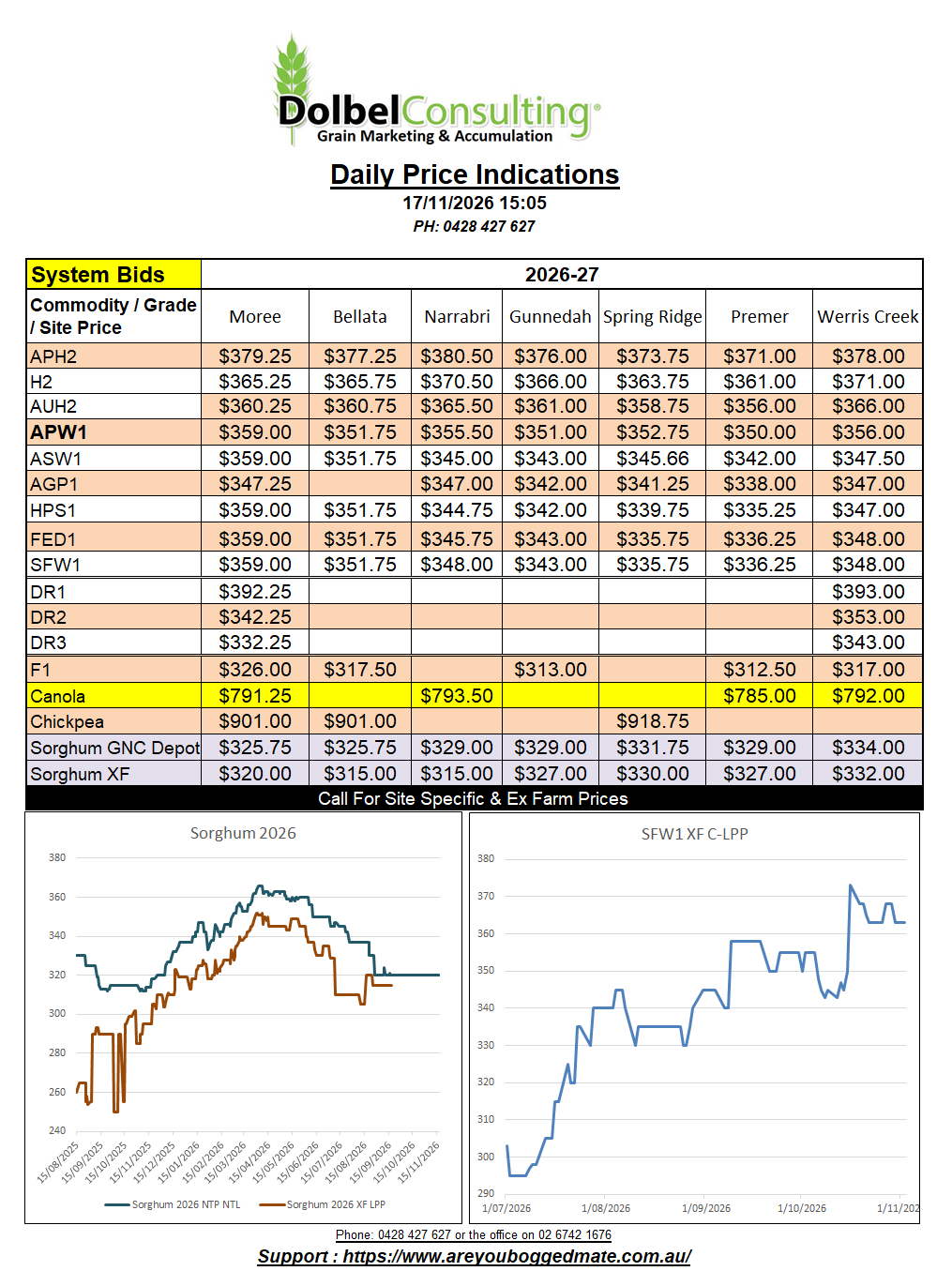
Bids were mixed yesterday. Track bids for lower grades were generally flat to firmer. This wasn’t seen across all sites though. The nature of the beast is for buyers to concentrate on specific sites and grades, often modifying values throughout the day.
The BAR1 market on the LPP was a little softer, bids coming in around $347 delivered local feed lot for a Nov / Dec spread. Off grade barley, BAR2 and BAR3, were shunned by the consumer and the trade. This is often the case during the harvest window. This isn’t restricted to the LPP, there was talk of Downs consumers rejecting sub BAR1.
Those holding BAR2-3-X on farm may need to wait the harvest period out. There’s not a lot of options at present. In years of tighter supply we often see the market reassess the usability of these grades of barley towards Q2-3 of the following year. We must also keep an eye on what the consumer has access to in the south. If the consumer can consistently pull BAR1 from the south and move it to the LPP / Downs market for similar money as what they are currently paying, they may simply do that for the rest of the year. Currently we see BAR1 trading at $285 XF lower CW-NSW. This product would land on the LPP for something close to $345, bang on where current consumer bids are.
Chickpea No1 closed the day bid at $945 delivered Narrabri. The current discount structure for CHKP2 is -$40 and CHKPM – $100. Theres not been a lot of off grade chickpeas delivered to date. The crop in the north held on a little better than expected. The Delhi market indicator was back 100Rs/Q last night, roughly -AUD$5.05/t lower. The Indian market is torn between rationing supply due to the high price and trying to import enough to get Indian stocks through to their harvest in Feb / March. Seeing the Delhi market find resistance, even with a smaller crop in the ground, tends to indicate this market may be top heavy.
7 day rainfall: Emerald CQ, 40mm to 70mm, Biloela 14mm, Rolleston 26mm, Roma 10mm – 60mm, Tara 10mm – 70mm, Dalby 20mm – 30mm, Millmerran 30mm to 60mm, Goondiwindi 0 – 20mm, North Star 15mm to 42mm, Garah 0 to 20mm, Moree 5mm to 20mm, Bellata 2mm to 17mm, Rowena 5mm to 30mm, Walgett 0 – 10mm, Narrabri 0 – 8mm, Coonamble 3mm, Boggabri 5mm to 15mm, Gunnedah 0 – 12mm, Spring Ridge 0 – 8mm, Dubbo 0 – 20mm, Parkes 2mm.
To say the weekend change produced less rain than expected would be an understatement. The heavier falls were generally along the ranges and coastal fringe. Storms were often severe producing hail and strong winds and in some places 100mm+ of rain.
The BOM synoptic charts shows a high moving east out of the Bight and consolidating off the east coast of NSW on Wednesday / Thursday. This should produce easterly airflow across CQ / FNQ feeding moisture into a tropical trough line deepening across the top end. The other main feature of the map is the development of a large area of low pressure over the WA wheat fields today and tomorrow.
There are currently isolated showers associated with this low across the northern half of the WA wheat fields, but falls have been minimal. Most models show light scattered falls across the Great Southern through to Sunday.
The low will follow behind the high leaving the Bight. The trough arriving across the eastern states late Friday. A hot weekend with the chance of a shower.