
5-6/10/26 Prices
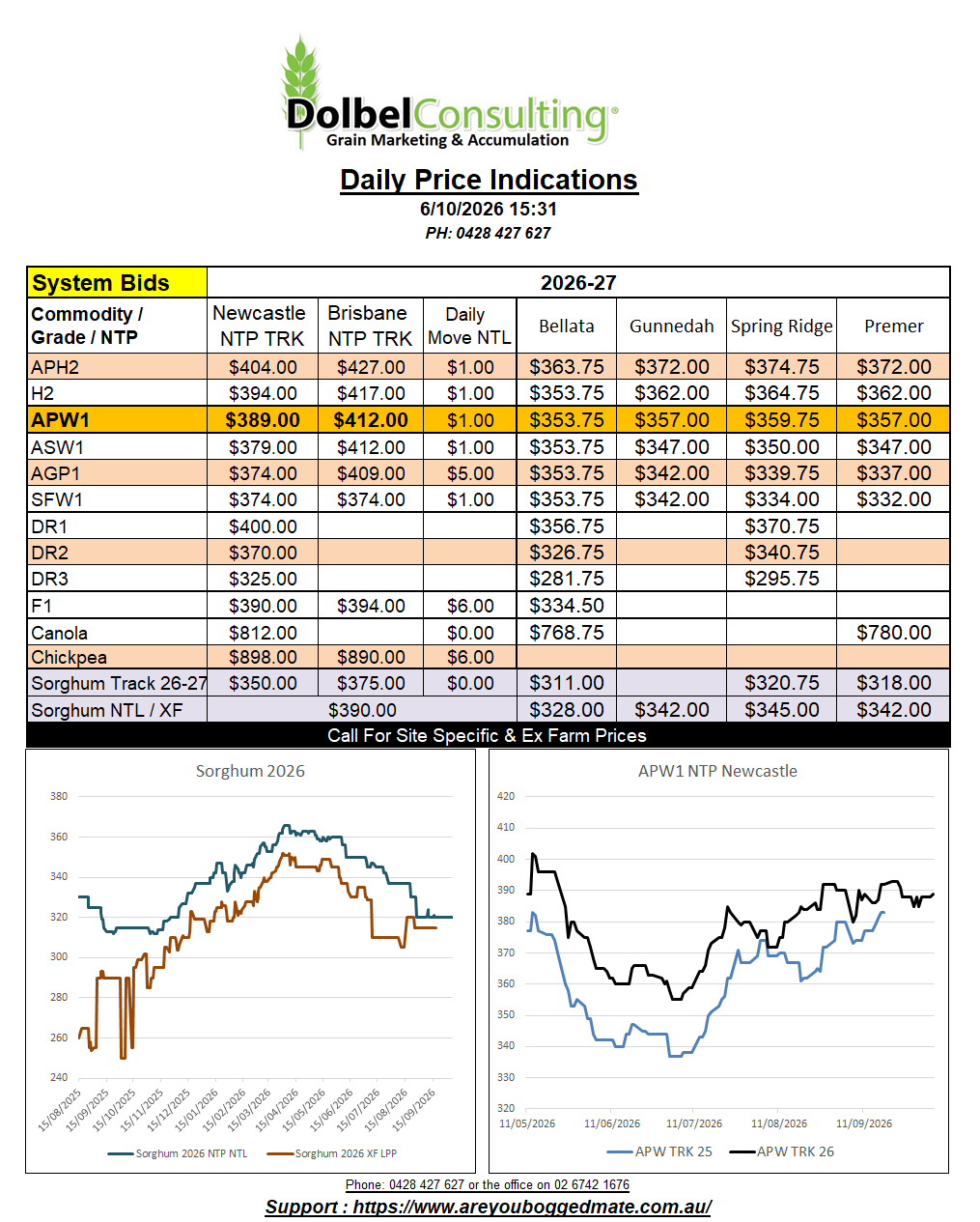
Saturday: Softer corn and soybean at Chicago continued to weigh on most US grain futures. Wheat was either side of unchanged depending on the grade. HRWW was the hardest hit, but only shed 2.25c/bu (AUD$1.18/t) in the December slot.
Hard red winter wheat values out of the US Pacific Northwest were down around AUD$3.06/t compared to yesterdays conversion.
Comparing US HRWW to Newcastle port zone H2 milling wheat basis Asian consumer tends to indicate that H2 is finally back to pulling a slight premium over US HRWW. H2 out of the Port Kembla zone at a comparable up country rate would be closer to a slight discount of maybe US$5.00 still. This could be indicating that the US international milling wheat market still has a ways to fall, possibly as much as 30c/bu just to become more competitive with Southern Hemisphere wheat over the next 3-6 months.
If we see a Black Sea resolution the US decline could be much sharper, but is hard to calculate. It would depend on how rates for both ocean freight and insurance fell for pickup from that part of the world. I have no doubt that Black Sea wheat would be the one to compete with. There’s a huge opportunity developing for those that can buy and sit on Black Sea wheat at current values. A perfect storm would be a corresponding resolution to Iran / Israel conflict.
As I write there is yet to be news on the results of the Saudi milling wheat tender.
Tunisia got a reasonable number of offers on their 100kt durum tender. Values ranged from a low of US$358.29 CiF to a high of US$383.92/t CiF. Let’s call it a midway point of about US$370 CiF. On the back of an envelope, it roughly equates to AUD$415 delivered port, so local new crop bids are at least in the ball park. The odds of NNSW durum making it to export versus an live stock ration, probably remote.
Monday: Saudi Arabia picked up 683kt of milling wheat at an average price of US$339.24/t. Offer values covered roughly a US$8.00 range from highest to lowest. Bunge, Cargill, Olam and Aston were the merchants, the usual candidates.
At US$339.24/t it roughly converts back to an XF LPP equivalent price of something in the ball park of AUD$360 to AUD$370 / tonne. That’s not far off the current values here in the north, and would indicate that Aussie wheat from southern and western ports could indeed work into that market if need be. Western Australian milling wheat is around AUD$368 FIS Kwinana. That leaves around US$60+ to get it to S.Arabia and make some margin.
French milling wheat is roughly US$268 FOB, that would land in S.Arabia for something closer to US$334 – US$340. This is a positive result for international wheat values.
We can assume it’s not about to be supplied by Russia or Ukraine. A Turkish operated ship carrying grain from the Ukraine port of Izmail on the Danube was struck by a drone, caught fire and sank off the coast of Romania.
The USDA weekly crop progress report has 23% of the corn crop in the bin. The week on week crop rating for corn declined from 44/13-57% G/E last week to 42/12-54% G/E this week. We continue to see social media posts of shot and sprung corn out of parts of SE Nebraska. US soybeans are 25% harvested, this is 8pts below the 5 year average pace. The soybean condition rating fell 1pt week on week to 57% G/E. Cotton G/E rating declined 2pts.
12% of the Kansas sorghum crop is now harvested, this takes the US crop to 32% complete. The condition rating was stable week on week, at just 26% G/E, there was a slight decrease in the portion of the crop rated poor to very poor.
US winter wheat sowing is progressing slowly, 36% complete versus the 5 year average pace of 46% complete by now.