
25/11/26 Prices
US wheat futures followed the path of least resistance, lower. All three major grades were softer both at the futures exchange and at the FOB cash level out of the Pacific Northwest.
White wheat cash values did buck this trend after a good US sale. The day to day conversion comparison for US Club White Wheat out of the PNW was up AUD$4.46/t. A complete contrast to the decline of AUD$4.43/t the hard red winter milling product saw in the day to day conversion comparison.
Does this tell us that there is a grower premium for white wheat, probably not. Club wheat is still trading at a AUD$15.00 discount to HRWW there.
US corn and soybean futures managed to close mostly in the green. The strength in soybeans failed to draw Paris rapeseed values higher. Winnipeg canola futures were also lower. Even a rally in crude oil, Brent up US$1.59/b, failed to stimulate the rapeseed and canola futures markets. The cash value for Canadian canola Dec lift was up CAD$7.00 XF SE Sask. Yesterdays failure of the local trade to track the international price higher may have been justified, but last nights fall in values, did not counter the increase from the previous session. All things being equal today, that may help stabilise bids here close to yesterdays values. If not, we are seeing a basis reduction, not that uncommon this time of year.
Paris milling wheat futures were mostly unchanged, the Dec slot was up E1.25/t, closing at E241.50/t, US$264.84/t. This compares to nearby HRWW futures at Chicago at US$225.05/t, that’s almost a US$40 premium to US values.
The EU are doing OK, they are picking up export sales that may usually be allocated to Black Sea wheat, they are achieving a domestic premium in comparison to US values in a lower production this year, and they have a new crop sown and rated at 94% good to excellent. The US leads the race to the bottom.
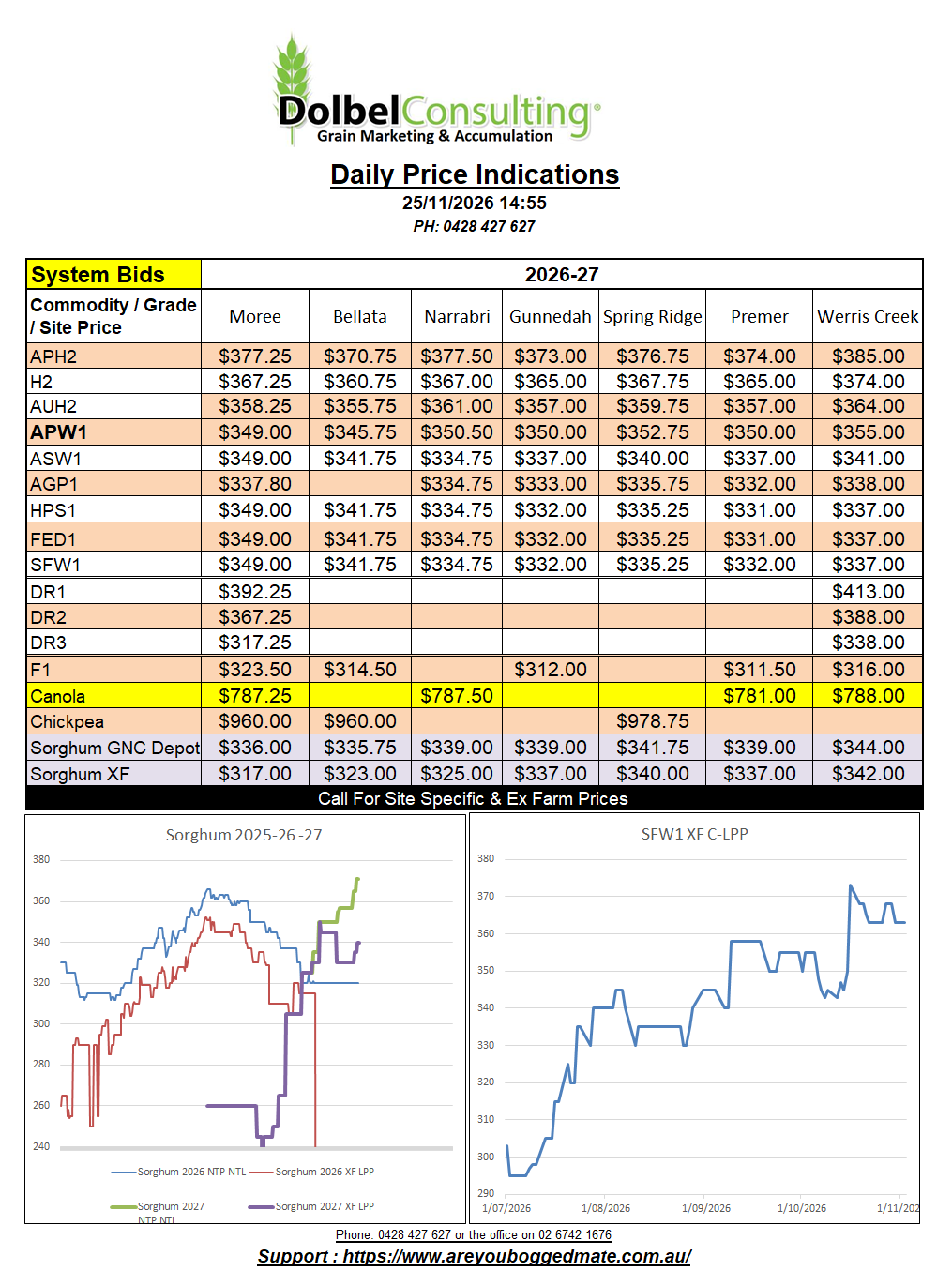
Locally we are continuing to see a premium for high protein wheat over the SFW1 market. APH1 changed hands at the equivalent Brisbane price of $470 yesterday. The freight difference is -$15.00 to -$20.00 if it went to the Downs, call it $450 delivered Downs equivalent. The SFW1 market was bid at $420 delivered Downs, so a $30.00 spread above SFW1. ASW / APW into the Brisbane market was bid at $435 delivered, -$35.00 to APH2.
On the LPP we are still seeing generic bids around $360 XF or $380 delivered local consumer for SFW1 or better type wheat.
The longer term outlook will depend on arbitrage values from the south into the local and northern consumer. The Downs and Brisbane markets will probably be the first to get capped. This is most likely due to the fact that they already know there isn’t enough wheat or barley in NNSW and SQLD to cover their demand through to next harvest. The feed market is happy to use either barley or wheat, the last 6 years has thought them a lot about feeding both.
The arbitrage is unlikely to be road, more so boat. Feed barley is roughly about AUD$308 FOB WA or SA port. Execution costs would run out at something close to $50 or $60 to get it on a truck at the Brisbane port, call it $360 FOT for the sake of the exercise. Add $40.00 to run it out to the Downs and you start to see a cap developing around $400.00 +/- deepening on trade margin and execution costs. Australia looks likely to produce a record feed barley crop this year, so supply like this will not be the issue. This does tend to paint a very flat picture for the feed barley.
SFW1 wheat is more likely to be arbitraged around road freight and supply from central and southern NSW. From a FOB port perspective we are already seeing ASW FOB Newcastle at almost a $60 premium to FOB Geelong, and a $30 premium to Pt Kembla.
Another change, another fizzer for many producers on the LPP. Yesterdays change produced some localised heavy falls but the falls were very isolated. Gunnedah airport picked up 5mm, 5ks south of town at the research centre they saw just 0.6mm in the gauge. Mullaley 25mm in places.
A heavy storm pushed through the Bellata area producing 20mm to 50mm, Rowena picked up 2mm to 12mm, Burren Junction 10mm to 30mm, Terry Hi 4mm to 20mm. Garah 0 – 20mm.
There’s a high cell off the east coast of Tasmania. This is directing moist easterly airflow across much of QLD and NSW this morning. There’s not much of a trigger for a storm today here on the plains, but SE QLD may see further storms. These storms may push further north into CQ as well.
There’s a trough line moving around the far west of the state and S.Aust. Rainfall between now and the weekend will generally be around that trough line, so well west of the wheat belt. There’s a pretty big gap between the high cell in the Tasman and the next high cell moving in from the west. This should allow the development of an area of low pressure to dip down across SA and SW NSW and across Victoria on Friday. This development will move the trough line east and onto the western edge of the NSW wheat belt on Friday night.
As the high moves in across the Bight and the area of low pressure moves SE, the trough will move east across the NSW wheat belt on Saturday / Sunday. The trough is expected to be slow moving. This may result in slow moving storms producing localised very heavy falls across the LPP Saturday night.