
24/8/26 Prices
Both Winnipeg canola and Paris rapeseed futures saw significant losses overnight. Winnipeg justifiably so, it had made some massive gains over the last couple of weeks on the back of outside markets. Paris rapeseed, although heavily influenced by some significant fundamentals like record drought, did see losses across all months. The Feb 27 slot closing off -€6.00/t.
The fall in rapeseed and canola futures rolled across the cash market. Ukraine values, which had remained surprisingly resilient, fell sharply, shedding roughly AUD$70.00 compared to yesterdays conversions. In order to buy demand into the EU market this had to happen. Ukraine farm values had to fall in order to counter the higher execution costs involved with avoiding the Black Sea. Whether or not the fall in Ukraine values will stimulate sales into the EU market is yet to be determined. Doing the math to make CiF cost comparisons into the EU consumer is also very difficult, logistics markets are very volatile at present.
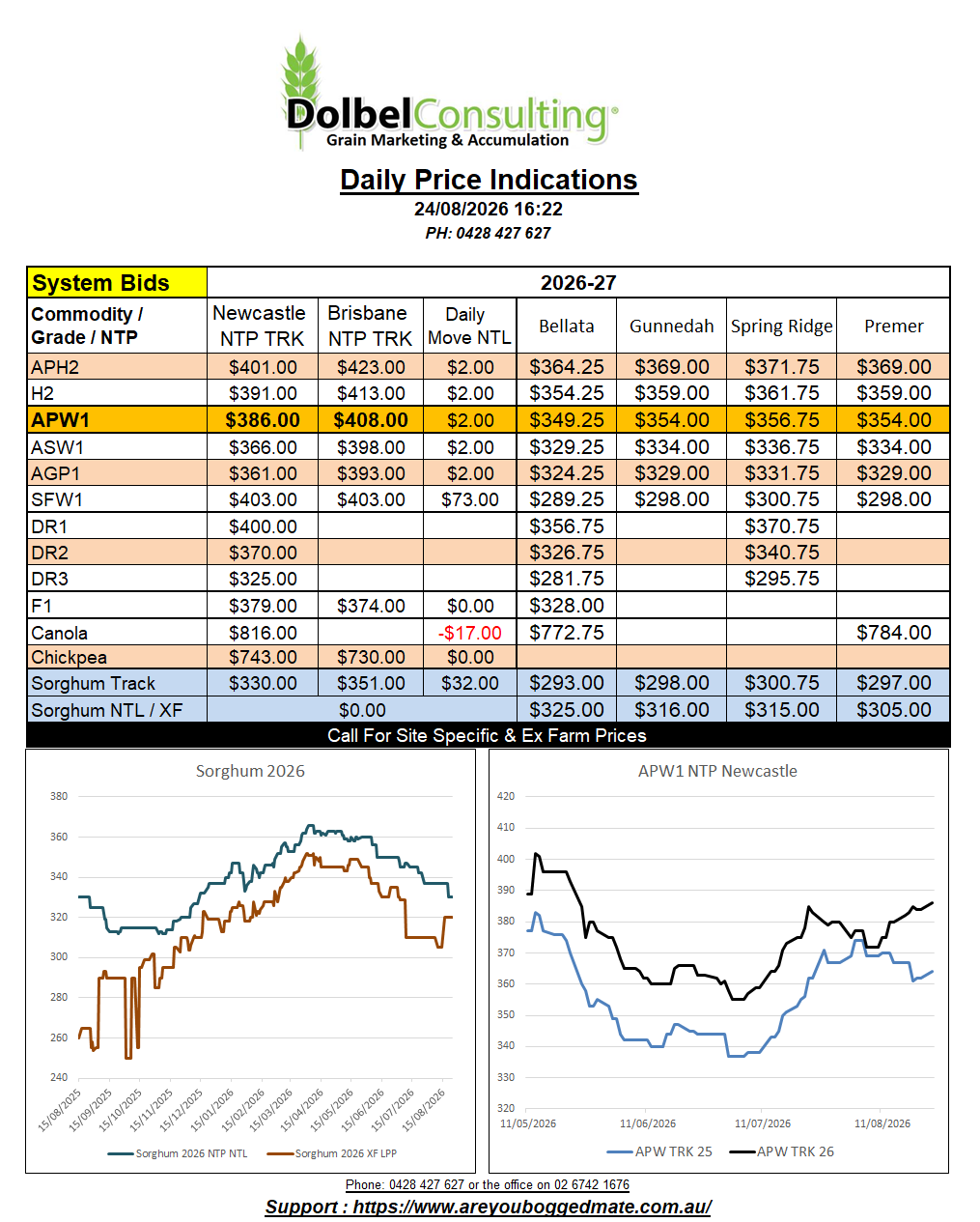
The decline in both Winnipeg canola and Paris rapeseed futures, and the cash markets, will very likely have a negative impact on new crop canola values here on Monday. The day to day conversion comparisons indicate a fall of AUD$17.38/t for the Paris conversion and a fall of AUD$26.16/t for the Winnipeg conversion. Local bids have generally followed the EU market indicator for a couple of years now.
US wheat futures took a breather, the more volatile grade, HRWW shedding the most value. Hard red winter milling wheat at 11.5% out of the US Pacific Northwest was valued at roughly US$306 FOB, placing it into the Asian market at something close to US$335.50/t. This is roughly US$5.00 above new crop Aussie H2 into the same market, and US$10.00 above some alternative suppliers.
If we are to sustain current wheat values we’ll need to see exports out of the Black Sea continue to be hobbled, and we’ll also need to see a sharp draw down on stocks, or a rise in offer value, from the likes of Romania and Bulgaria.