
13/5/26 Prices
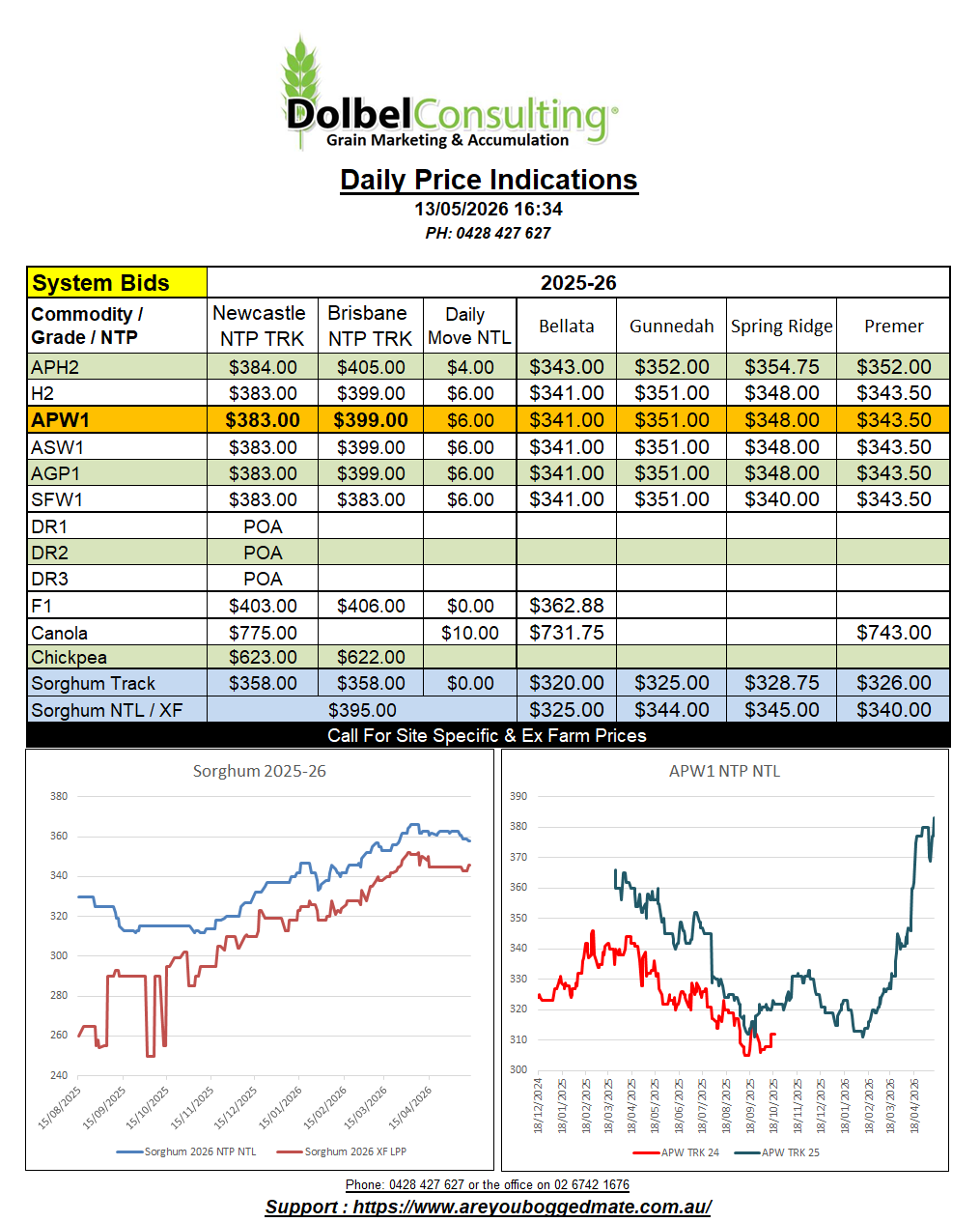
Chicago wheat futures focused a little more closely on the weekly USDA crop progress report last night, probably giving the decline in winter wheat crop condition in Kansas the attention it deserved. Chicago HRWW jumped 45c/bu, or if you live in the 21st century, that’s roughly AUD$22.84/t at this mornings USD/AUD exchange rate.
Be aware this is currently a US issue. Droughts cause localised spikes until it becomes a supply issue for domestic consumers at the extremity of the draw arc. Then it may become additional demand for international market. I can’t see US HRWW values climbing to import parity quickly, but there will be locations nearer the east coast that can buy EU wheat cheaper than they can draw grain in from the west in time. We’ve already seen Polish wheat move into a US consumer to see them through to harvest.
We are seeing a similar issue here on the east coast of Australia with the current drought. The reason I mention this is for those that track basis. We may well see a much smaller reaction in local values than expected today. The move does take US HRWW to roughly US$323 C&F Asia, H2 is roughly US$324. This does open the door for Russia. Black Sea values gained just AUD$2.00 to AUD$3.00 overnight. Black Sea milling wheat is roughly US$290 C&F Asia.
Is this a bad thing. Considering drought here and the US, it’s probably perfectly timed to get rid of some Russian stocks and tighten the supply chain up leading into the 2026-27 marketing year.
The USDA WASDE report took a stab at the 2026-27 production this time around. They did make a few adjustments to the 2025-26 sheet that are worth a mention. World ending stocks (2026-27 carry in) was up 3.91mt, but the bulk of this was in major consumer, importers possibly buying up cheap wheat. N.Africa is having a good season too. +1.6mt to Kazakhstan is interesting. New season production was estimated at 819.06mt, back 24.78mt YoY. World ending stocks predicted to fall just 4.17mt. This is all bullish, but the US is US centric, concentrating on the smallest wheat crop since 1965.